December 17, 2025
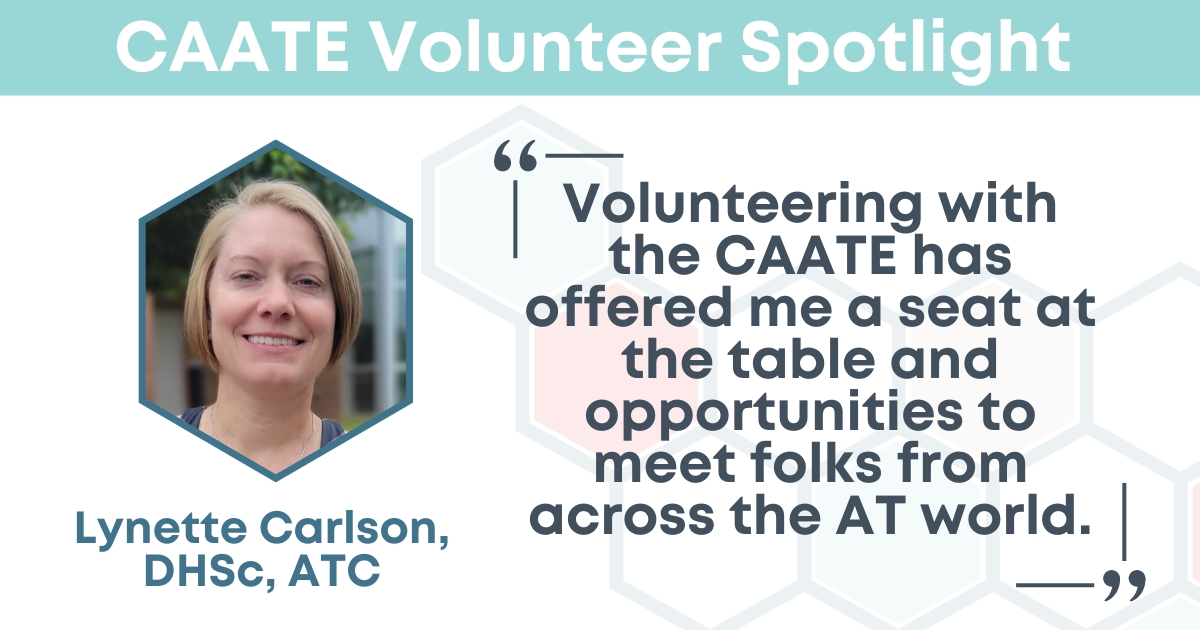
The CAATE is proud to recognize the inspiring achievements and dedicated work of Lynette Carlson, DHSc, ATC. Lynette serves the CAATE on the Diversity, Equity, Inclusion, Accessibility and Leadership Development Committee.
How did you become involved with athletic training?
I know I wanted to be an AT since I was 15 years old. I tore my ACL in high school and physical therapy followed. I was interested in PT until an athletic trainer came into the clinic to test my strength on an isokinetic dynamometer. I asked my PT, “What does he do?” She proceeded to tell me that he spent his afternoons and evenings at a local high school providing medical care to the athletics programs and came into the clinic on occasion to perform return to sport testing. I thought that aligned with my interests perfectly – medicine and athletics, and never looked back!
How did you become involved with the CAATE?
When catching up on my reading I stumbled across a call for volunteers for a new CAATE committee – the DEIA and Leadership Development Committee. After learning more, I was excited to apply. I thought it was a long shot! I didn’t have formal, national volunteer experience, but I felt like this committee matched my experience well. When I received the phone call from committee chair, at the time, Dr. Toni Torres-McGehee inviting me to be a member, I was shocked and honored to contribute to this important work!
What are some highlights from your athletic training career?
I look at my career as having several micro-wins. Throughout my career, I said, “yes,” to every opportunity that crossed my path, which has afforded me growth in ways I could never imagine. My career has taken many twists and turns that has maybe made me a master of none! I’m ok with that, though, because I love variety. I’ve worked in a lot of settings – high school, college, pro, physician practice, outpatient rehab, education, middle-management, performing arts, extreme sports, and even hospice. If I think back to each position, a highlight jumps to the front of my mind. Maybe you’re surprised by my hospice experience, so I’ll share that highlight. I was hired by a hospice company to coordinate medical students’ clinical rotations and to educate employees on the company culture. This job was a surprise to me, one I applied to after being laid-off; I just needed a job. I LOVED my time with these amazing angels that care for people during their final days. I learned SO MUCH about the benefit and right to hospice care. I shared time with one of my roller derby athletes under our care, battling breast cancer. I bonded with chaplains that played music to soothe patients’ and families’ hearts. During my time at hospice my grandma fell ill, so I was equipped to help my family though end of life care and to get Grandma Blender supported by the caring people of hospice. Everything happens for a reason. I was laid-off. I was angry. I got a job I wasn’t sure about. But I was where I needed to be, when I needed to be there, and I came out stronger in the end.
What is a highlight from your involvement with the CAATE?
My 1st trip to Washington D.C. for committee day is full of fond memories! We were a new committee, coming out of COVID, with lots of energy and steam to accomplish big tasks! Volunteering with the CAATE has offered me a seat at the table and opportunities to meet folks from across the AT world. Meeting the rest of the committee in person and seeing how we worked together, listened to one another, and problem-solved together showed me how a diverse group of people with an inclusive mindset can accomplish great things! Another highlight was when I joined a subcommittee reviewing Standards language. During one of the Zoom meetings, I chimed in with a recommendation of wording and they accepted my input. “I changed a CAATE Standard just by speaking up!” That revelation made me appreciate the importance of having a seat at the table and using my voice!
In your words, how do you believe you are contributing to the CAATE mission?
(The CAATE mission: Serving as a catalyst to advance athletic training education through the promotion of quality improvement, innovation, diversity, and best practices for student recruitment.)
As a volunteer, I do my best to contribute to the CAATE mission by being an active committee member, having a growth mindset, being open to new ideas, being prepared for meetings, completing action items, contributing ideas with integrity, offering thoughtful solutions, and lifting all voices.
Why do you believe students, faculty, and athletic trainers should become involved with the CAATE?
Accrediting athletic training education is a big lift and it takes us all! Volunteering with the CAATE has offered me the opportunity to connect with amazing ATs across the nation. There is so much talent in our profession and my circle of friends continues to grow the longer I volunteer! Working with other motivated people who are willing to volunteer makes me realize how we move the profession forward – together!
Can you share words of inspiration or a quote about your experience in athletic training or the CAATE?
My first mentor and supervisor, Robbie Williams, told me it was good practice to educate our patients with all the information we know. I don’t remember his exact quote, but he essentially said, “Don’t be afraid to share your knowledge.” The background scenario was this: a high school athlete tore his ACL/MCL during a football game and when I did the valgus stress and anterior drawer tests the knee went to Georgia and back (I was in Tennessee). I knew what the diagnosis was, but I wasn’t comfortable sharing that information with the athlete or parents. Robbie was there observing me and after they left my ATR he asked if I knew what was wrong. I said, “Yes. He tore his ACL and MCL.” He asked why I didn’t tell them, to which I shrugged my shoulders. He encouraged me to be a caring patient advocate and help patients begin to cope with major injuries. We are an important support system for our patients, and it starts with telling them the whole truth. I have never forgotten that lesson and am grateful that I learned early in my career to not withhold information from my patients!